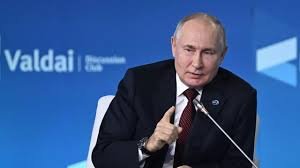
In recent times, a stark question has haunted the halls of diplomacy and international law: what would happen if Vladimir Putin, the president of Russia, were to land on American soil? With an active arrest warrant from the International Criminal Court (ICC), his presence at a summit in Washington or New York would trigger a geopolitical firestorm.
This isn’t just a hypothetical exercise. It’s a scenario that forces the United States to confront its own complex identity on the world stage. What prevails: the demand for international justice or the brutal realities of global power politics?
If you are interested in global affairs, a student or professional of law and foreign policy, or simply a citizen trying to understand America’s role in the world, this post is for you. We will break down, clearly and directly, what this high-stakes situation reveals about international law and the profound dilemma facing the United States.
The Starting Point: Why Did the International Criminal Court Issue an Arrest Warrant?
First, let’s understand the context. The International Criminal Court, also known as the ICC or the Court at The Hague, issued an arrest warrant for Vladimir Putin in March 2023. The charge is of the utmost gravity: war crimes. Specifically, the unlawful deportation and transfer of children from occupied areas of Ukraine to the Russian Federation. Under international law, this is one of the most severe violations that can be committed during a conflict. It is crucial to note: the ICC does not prosecute countries, it prosecutes individuals. Its goal is to ensure that those responsible for the world’s most heinous crimes—genocide, crimes against humanity, and war crimes—cannot act with impunity.
The Origin Story: From Nuremberg to The Hague, the Slow Pursuit of Global Justice
A court like the International Criminal Court did not emerge from a vacuum. It is the product of a long and often painful evolution of international law. After World War II, the Nuremberg Tribunal was established to prosecute Nazi war criminals. While historic, it was criticized by some as “victor’s justice.”
Decades later, in the 1990s, the world watched in horror at the genocides in Rwanda and the former Yugoslavia. In response, the UN created specific (ad hoc) tribunals to prosecute these crimes. It became clear that creating a new court for every new atrocity was unsustainable. A permanent, independent, and impartial court was needed to hold individuals accountable, regardless of their official title or nationality. From this ambition, the ICC was born in 2002. The United States was a key player in the Nuremberg trials and the ad hoc tribunals, creating a stark contrast with its position on the ICC today.



The American Anomaly: The U.S. and the Rome Statute
Here, the story takes a sharp turn away from the Brazilian context. While Brazil ratified the Rome Statute and made it law, the United States did the opposite. This is the single most important fact in understanding the American dilemma.
The United States is not a party to the Rome Statute.
The U.S. has a deeply complicated history with the International Criminal Court. The Clinton administration signed the treaty in 2000 but had reservations and did not submit it to the Senate for ratification. In 2002, the George W. Bush administration took the unprecedented step of “unsigning” the treaty, signaling a complete rejection of the court’s jurisdiction.
The opposition is rooted in a core concern: the potential for the ICC to be used for politically motivated prosecutions against American soldiers, intelligence officers, and even high-ranking officials. This fear led to the passage of the American Service-Members’ Protection Act (ASPA) in 2002, often dubbed “The Hague Invasion Act.” This law explicitly forbids U.S. government agencies from cooperating with the ICC and even authorizes the president to use “all means necessary and appropriate” to free any U.S. or allied personnel detained by the court.
A Moral and Political Crossroads: America’s True Dilemma
Without a legal treaty obligation, the dilemma for the United States becomes purely political and moral, which is arguably even more complex. If Putin were to arrive, the U.S. would be caught between its proclaimed values and its strategic interests.
- The Case for Action: The U.S. has historically been a loud proponent of international justice and accountability for war crimes—when committed by others. To ignore a warrant for crimes of this magnitude, especially when leading a global coalition to support Ukraine, would be seen as profound hypocrisy. It would undermine the very “rules-based international order” that the U.S. claims to champion.
- The Case for Inaction: Arresting the sitting leader of a major nuclear power would trigger an unprecedented geopolitical crisis. The diplomatic fallout would be immense, potentially escalating the conflict in Ukraine and shattering any remaining channels of communication with Moscow. Furthermore, it would be criticized by nations that view the ICC as a tool of Western powers, especially given the U.S.’s own refusal to be subject to its jurisdiction.
The Consequences of Any Choice: The South Africa Precedent
There are no easy answers, and either path carries severe consequences. We can look to a real-world example to understand the political cost. In 2015, South Africa, an ICC member, failed to arrest Sudanese President Omar al-Bashir, who also had an ICC warrant for genocide. The fallout was immense: South Africa’s own Supreme Court declared the government’s inaction illegal, and its reputation as a moral leader on the continent was severely damaged.
While the U.S. would not face a domestic legal crisis like South Africa did, the international reputational damage would be similar, if not greater.
- If the U.S. does nothing: It would be accused of moral cowardice and hypocrisy, weakening its leadership position and giving a green light to impunity for powerful actors.
- If the U.S. acts: It would risk a direct confrontation with Russia and be accused of reckless overreach, applying a law to others that it refuses to accept for itself.
Want to master these topics? Cases like this show that international law is no longer an abstract field; it directly impacts geopolitics, business, and legal careers. For professionals, scholars, and foreign policy students who want to not only understand but also operate within this global landscape, in-depth knowledge is a critical competitive advantage. If you seek that expertise, explore our Advanced Course in International Law and Geopolitics, the definitive toolkit for navigating these complex issues with confidence.
Ultimately, this scenario forces a foundational question about America’s role in the 21st century. Is it a nation bound by the same rules it advocates for others, or is it an exception? The answer would define U.S. foreign policy for decades to come.

Deixe um comentário